
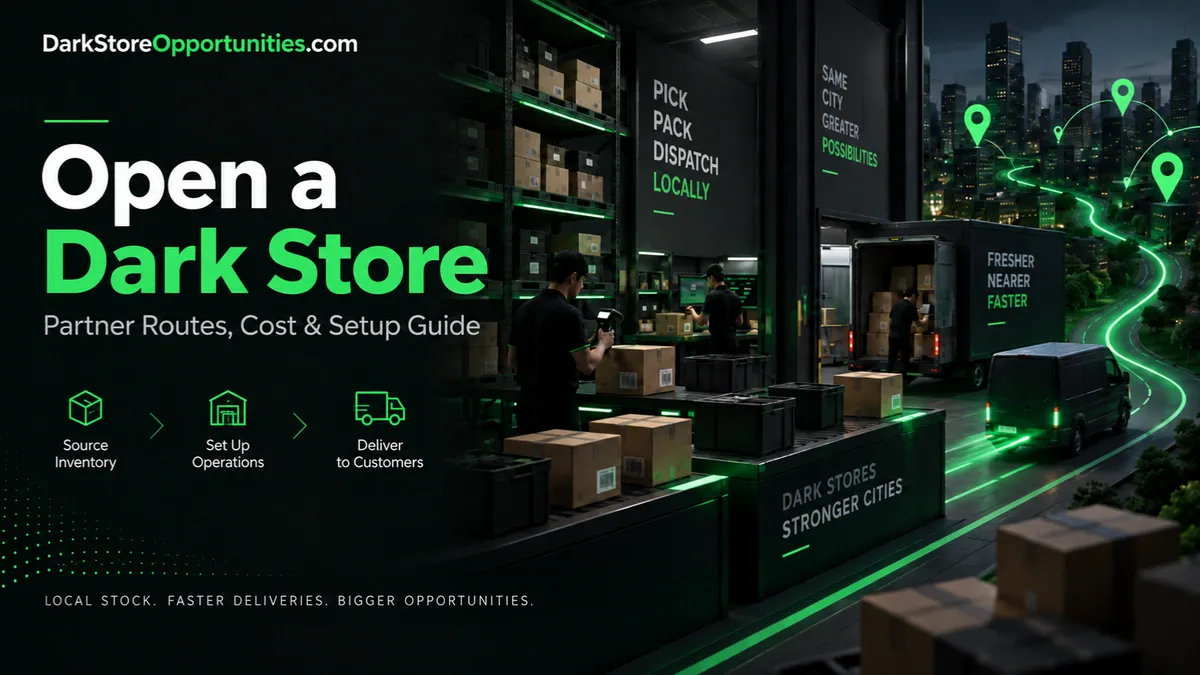
This is the complete DarkStoreOpportunities.com guide to opening and setting up a dark store in India. It brings the full journey into one place: choosing the right business route, checking current partner opportunities, understanding cost heads, evaluating a site, planning the store, building the team and preparing for day-to-day operations.
Best starting point: first confirm the operating model and company route; then build the property, budget and setup around the approved requirements. A dark store is an operations-led fulfilment business, not simply a warehouse with racks.
First, choose the opportunity you actually want
“Dark store opportunity” can mean different things. Pick the route that matches what you want to do.
Open or operate a dark store
You want to run store operations: receiving, inventory, manpower, picking, packing and service standards under an approved model.
Lease a suitable property
You own or control commercial space and mainly want the property evaluated for a quick-commerce dark store.
Sell or supply products
You are a brand, manufacturer, distributor or seller looking for quick-commerce seller/onboarding routes.
What is a dark store and how does it work?
A dark store is a fulfilment location built primarily for online orders rather than walk-in shopping. Inventory is received and stored inside the facility; when an order arrives digitally, items are picked, packed and handed over for last-mile delivery.
The exact responsibility split varies by platform and agreement, but a dark-store operator may be responsible for store-level manpower, inventory discipline, licences and compliance, housekeeping, uptime, receiving, storage, picking, packing and handover.
Current dark-store partner routes in India
Companies use different labels—partner store, franchise partner and growth partner are not necessarily identical models. These are the public routes currently relevant to an operator evaluating the market.
Blinkit Partner Store
Blinkit publicly invites entrepreneurs to run partner stores. Its partnership ecosystem separately includes property and seller routes.
Swiggy Instamart
Instamart’s official partner page includes a franchise-partner route and separately provides seller and property options.
Zepto
Zepto operates dark stores directly and through Growth Partners. Its official franchise portal provides the current application route.
Amazon Now
Amazon is rapidly expanding its micro-fulfilment network, but we have not found a comparable public self-service dark-store operator application route in the current review.
Flipkart Minutes
Flipkart Minutes has expanded its micro-fulfilment network across 150+ cities. A comparable public self-service operator/franchise route was not identified in this review.
Compare company opportunity routes →
How to open a dark store in India: step by step
Choose your role and operating model
Decide whether you want to operate a dark store, lease property or supply products. If you want to operate, focus on partner/franchise/growth-partner routes.
Choose the city and target catchment
Start with a city and a few practical micro-markets. Quick-commerce viability is local: demand density, serviceability, access and network plans matter at neighbourhood level.
Prepare your operator profile
Keep your business background, investment range, city, operating experience and property status ready so the opportunity can be assessed meaningfully.
Apply through the relevant route
Use the current official partner/application path. Company labels and onboarding processes differ, so follow the route that matches your profile.
Understand the commercial model
Review responsibilities, fees, payment formula, inventory responsibility, manpower, operating metrics, deposits, lock-ins, renewals and termination terms.
Get the market and site aligned
Shortlist property only after understanding the target catchment and site expectations. A large or cheap property is not automatically a good dark-store location.
Freeze the approved store plan
Confirm layout, storage zones, electrical load, cold-chain needs, access, fire/safety work, IT/connectivity and responsibility split before major fit-out spending.
Build infrastructure and SOPs
Install the required storage and operating infrastructure, document receiving/picking/packing processes and set up inventory and housekeeping routines.
Recruit and train the store team
Build shift coverage around store management, receiving/inventory, picking/packing and other functions required by the operating model.
Run pre-launch checks and go live
Test stock accuracy, equipment, connectivity, workflows, handover points, safety basics and escalation ownership before live order volume begins.
Dark Store Setup in India: what the facility actually needs
Once the operating route and site direction are clear, the physical setup should be designed around one objective: move inventory accurately from receiving to customer handover with minimum unnecessary movement.
1. Property and location fit
Demand & serviceability
The site should support the platform’s target delivery catchment and network plan, not simply be located in a busy city.
Inbound & rider movement
Plan for replenishment vehicles, rider movement, loading/unloading and safe entry/exit without creating avoidable bottlenecks.
Power & basic services
Electrical capacity, backup needs, washrooms, connectivity, ventilation and other utilities should match the final store specification.
Blinkit’s current property-rental page lists 2,000 sq ft minimum carpet area, 9 ft minimum height, parking for at least 40 bikes, truck drive/parking space, minimum 30 KV electricity and two washrooms. Treat these as Blinkit property-route requirements—not a universal specification for every company.
2. Plan the internal zones before buying equipment
3. Core infrastructure and equipment
Storage system
Racking, shelving, bins, product location labels and safe aisle planning based on the assortment and picking method.
Cold chain
Chillers, freezers, cold rooms and temperature-control equipment only where required by the approved product mix and operating plan.
Electrical & backup
Lighting, sockets, equipment load, stabilisation/backup and safe electrical distribution sized for the final setup.
Technology & connectivity
Reliable internet/networking, devices, printers/scanners or other equipment required by the platform’s store workflow.
Security & safety
CCTV, controlled access, fire/safety equipment, clear movement paths and local requirements appropriate to the premises.
Packing & housekeeping
Packing stations, consumables, waste handling, cleaning tools and simple standards that keep the store fast and organised.
4. Build the team around the workflow
Team size and role names vary by store and company, but the work normally needs clear ownership for:
- Store/shift supervision
- Inbound receiving and putaway
- Inventory accuracy and replenishment
- Order picking
- Packing and order verification
- Dispatch / rider handover
- Housekeeping and basic upkeep
- Exception handling and escalation
5. Set operating routines before launch
Receiving SOP
Count, check condition, record shortages/damage and move accepted inventory into the correct location quickly.
Inventory SOP
Maintain location discipline, replenishment, cycle counts, expiry/lot handling where relevant and clear exception stock.
Order SOP
Define pick → verify → pack → stage → handover so every shift follows the same basic operating rhythm.
How much investment is required?
There is no single dark-store setup cost that applies to every company and city. The useful approach is to build a budget from the actual model and responsibility split.
| Budget head | What can sit inside it | Decision point |
|---|---|---|
| Property | Deposit, rent, brokerage if any, access improvements | Is the site approved and commercially workable? |
| Fit-out | Civil work, lighting, electrical, flooring/repairs, signage where applicable | Who pays and what specification is required? |
| Storage | Racks, shelves, bins, labels and handling fixtures | What assortment and storage plan are approved? |
| Cold chain | Chillers, freezers, cold room/cooling equipment | Is temperature-controlled inventory part of the store? |
| Technology | Internet/network, devices, scanning/printing and related systems | What is supplied by the platform versus partner? |
| People | Recruitment, salaries, shift coverage and statutory costs | What staffing model is expected? |
| Compliance & safety | Registrations, permits, fire/safety and professional fees where applicable | Which obligations sit with the operating entity? |
| Working buffer | Early operating expenses and contingency | How much runway is sensible for your agreement? |
Budget rule: finalise the commercial offer, approved site and responsibility split before treating any generic online “franchise cost” as your investment figure.
What should you monitor once the store is running?
The company may have its own metrics, but an operator should understand the operating health of the store. Useful areas to monitor include:
- Inventory accuracy
- Order/picking accuracy
- Picking and packing workflow time
- Stock-outs and replenishment discipline
- Damage, wastage and shrinkage
- Store/equipment uptime
- Staff attendance and shift coverage
- Cleanliness and operating discipline
Dark store pre-launch checklist
- Operating/partner route and agreement are clear.
- Site/catchment has been accepted for the intended model.
- Layout and equipment responsibilities are frozen.
- Power, connectivity and required backup are working.
- Racks/storage locations are labelled and usable.
- Cold equipment is tested where required.
- Receiving, pick, pack and handover flow has been trialled.
- Team roles and shift ownership are clear.
- Required registrations/compliance are in place for the operating model.
- Escalation contacts and exception processes are documented.
Keep four things clear in writing: the contracting entity, site approval, commercial responsibility split and final store specification. That single discipline prevents most avoidable setup mistakes.
Frequently asked questions
Is a dark store the same as a normal retail franchise?
No. A dark store is built around fulfilment of online orders, and the commercial/operating model varies by company. Some companies publish partner or franchise routes; others may operate their network differently.
Can I open a dark store independently?
You can build an independent fulfilment operation, but that does not automatically make it part of Blinkit, Instamart, Zepto, Amazon Now or Flipkart Minutes. If your objective is a specific platform, start with that platform’s current route.
Do I need to own a property before applying?
Not necessarily. It depends on the operating model. If you already have a property, include it in your profile; otherwise, avoid taking a long lease before the target route and site requirements are clear.
What size property is needed for a dark store?
There is no universal size for every operator. As one current benchmark, Blinkit’s property route lists a minimum 2,000 sq ft carpet area, but other companies/models can have different requirements.
How much does a dark store cost to set up?
Cost depends on property, fit-out responsibility, storage system, cold-chain requirement, technology, manpower, compliance and the commercial agreement. Build the budget from the approved model rather than a generic headline figure.
What equipment is normally needed?
Typical categories can include racks/shelving, bins, packing stations, networking/devices, CCTV, electrical/backup systems and—where the assortment requires it—chillers/freezers or other cold-chain equipment.
How many people are needed?
There is no universal headcount. Staffing depends on order volume, operating hours, automation, store size and the platform’s process. Plan clear coverage for receiving, inventory, picking, packing, dispatch and supervision.
Which company should I apply to?
Compare the routes actually available for your city/profile, the responsibility split, site requirements and commercial terms. Brand name alone should not decide the operating model.
Ready to evaluate your profile?
Share your city, investment range, operating background and property status. We can use that information to identify the most relevant next step.